Police State USA by Cheryl K. Chumley
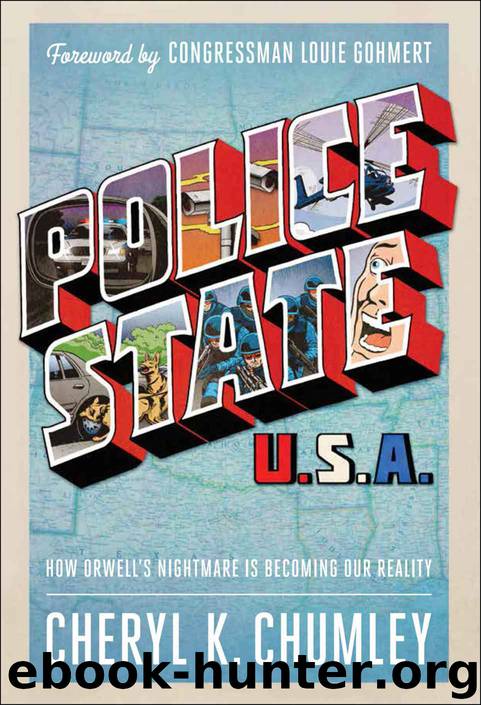
Author:Cheryl K. Chumley [Chumley, Cheryl K.]
Language: eng
Format: epub, mobi
Publisher: WND Books
Published: 2014-05-27T00:00:00+00:00
14
THE BAFFLING WHITE HOUSE EMBRACE OF RADICAL ISLAMISM
It is our true policy to steer clear of permanent alliance with any portion of the foreign world.
– George Washington, Farewell Address
There’s regular American logic. There’s Inside the Beltway, career politician logic. And then there’s American overseas policy logic. And when the three clash, as they did in 2013 over US policy in Egypt, chaos results.
Hosni Mubarak was appointed to the presidency in Egypt after Anwar Sadat was assassinated in 1981. He served in the role for three decades – the longest-serving Egyptian president ever – and enjoyed a mostly cordial relationship with the United States, helping the allied forces drive Iraqi troops from Kuwait in the 1991 Gulf War and joining with the Arab League’s push for an Arab-Israel peace plan.1 He also ruled his nation with an iron fist – but to the United States, that was actually an unspoken positive that kept in check more radical Islamic forces in the region.2
Corruption plagued his presidency, however, and he resigned amid a widespread and weeks-long protest that took over the streets of Cairo in 2011.3 It was during these eighteen days of violence that tore at the nation, pitting pro-Mubarak supporters against a mostly youthful crowd that demanded a more democratic rule, that the United States distanced itself from the leader.4
In early February 2011, President Obama called for Mubarak to quickly leave office and put an end to the clashes. Cairo officials reacted to the swift and blunt order from their former White House friends with fury, accusing the United States of ratcheting up the violence and wrecking any chances for a peaceful Mubarak departure, complete with a smooth transition of power.5
Then came Mohamed Morsi, who won a narrow election in June 2012 to become Egypt’s fifth president, and its first of pure Islamist belief.
Backed by the Muslim Brotherhood, a group that Mubarak had outright banned, Morsi took over the presidency with promises to govern for all of Egypt rather than for solely Islamist interests.6 He also vowed to create a constitution that included input from Coptic Christians and women.7 America welcomed him. President Obama made a personal telephone call to congratulate the Islamist leader on his win in late June 2012, pledging US support for his push to move Egypt toward democracy and touting a mutual respect for the new leader.8 Then secretary of state Hillary Rodham Clinton traveled to Egypt in mid-July to personally welcome the new leader to his post and express America’s support for his full transition to office.9
She largely ignored the elephant in the room, as did other American leaders: The military that controlled Egypt in the months between Mubarak and Morsi was still a thorn in the new president’s side. Generals that had been loyal to Mubarak weren’t so happy with Morsi or with his Muslim Brotherhood influences.
Meanwhile, Morsi basically took his US endorsement and ran. Shortly after taking office, he issued a decree that granted him dictator-type powers.10 Egypt howled. Facing pressure from around the
Download
This site does not store any files on its server. We only index and link to content provided by other sites. Please contact the content providers to delete copyright contents if any and email us, we'll remove relevant links or contents immediately.
| Anthropology | Archaeology |
| Philosophy | Politics & Government |
| Social Sciences | Sociology |
| Women's Studies |
The Secret History by Donna Tartt(19002)
The Social Justice Warrior Handbook by Lisa De Pasquale(12177)
Thirteen Reasons Why by Jay Asher(8874)
This Is How You Lose Her by Junot Diaz(6857)
Weapons of Math Destruction by Cathy O'Neil(6249)
Zero to One by Peter Thiel(5767)
Beartown by Fredrik Backman(5717)
The Myth of the Strong Leader by Archie Brown(5482)
The Fire Next Time by James Baldwin(5409)
How Democracies Die by Steven Levitsky & Daniel Ziblatt(5200)
Promise Me, Dad by Joe Biden(5130)
Stone's Rules by Roger Stone(5065)
A Higher Loyalty: Truth, Lies, and Leadership by James Comey(4937)
100 Deadly Skills by Clint Emerson(4900)
Rise and Kill First by Ronen Bergman(4761)
Secrecy World by Jake Bernstein(4727)
The David Icke Guide to the Global Conspiracy (and how to end it) by David Icke(4685)
The Farm by Tom Rob Smith(4489)
The Doomsday Machine by Daniel Ellsberg(4474)
